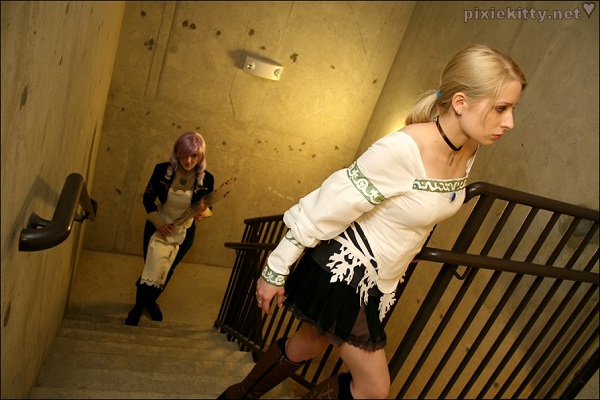
Fate Zero

Fate zero is agreat anime with amazing animation with a superb plot

Red Alert 3 + Uprising

Review of Command and Conquer Red Alert 3 and Uprising featuring Girls of Red Alert

GTA Sanandreas Mod Installer

replace your GTA Sanadreas vehicles with new ones with improved graphics and modes

Dead or Alive 5

Prieview of Dead or Alive 5 for PS3 and Xbox 360

Final Fantasy XIII review

Complete review of final fantasy XIII with some cute cosplay

Slideshow

Tuesday, 3 January 2012

Final Fantasy XIII (PS3, XBOX 360)


Review by GooberSD

It has been almost five years since Square first unveiled Final Fantasy XIII to the world in 2005. After countless delays, and an intense advertising campaign, Final Fantasy XIII is finally here for the Playstation 3 and the Xbox 360... but mostly for the Playstation 3. The world has been waiting for the game like little children waiting for Santa Claus on Christmas Eve. Now that it has finally been released, people can't help but wonder, "Is the game any good?" You can't blame them for wondering this; since many found XII to be a disappointment. (I did not.)


The truth about Final Fantasy XIII is that it is fantastic. Directed by Motomu Toriyama, the director of Final Fantasy X, Final Fantasy XIII offers a unique take on the Final Fantasy series that is both good and bad.

Story
I will avoid speaking about the game's story for obvious reasons. But I will say that the story to Final Fantasy XIII is just as epic and original as the other games, for the most part.


The story is split into thirteen different chapters, each being a different length and each telling different stories. The game's prologue is rather lengthy. It wasn't until Chapter Five or Six that the story finally started to move in a direction. This was a bit of a bother to me, since that was about twelve hours into the game. This might not be a problem for some, but for me, the pacing was slow. If you've played any Final Fantasy before you'll notice how powerful the narratives are. Final Fantasy XIII is no exception. The game plays out almost like a movie with several cinematic cut-scenes that easily break the ten and some times fifteen minute mark. The game is by far the most cinematic Final Fantasy to date, and that's not a bad thing.

Half of the story of Final Fantasy XIII is told through cut-scenes, and the other half is told through your datalog. Your datalog is an in-game encyclopedia that offers a large variety of information that tells you plenty of back-story and details that you otherwise wouldn't find out about. The story to Final Fantasy XIII is much shorter than the previous games. Players will be able to complete the full game in less than forty hours. The excellence story and characters make up for the length though.

The protagonist Lightning is the first true strong female protagonist that the entire series has ever seen. Lightning is easy to relate too, and has layers of her personality that make her a complicated character. Even though she starts out as a dull character that seems like another Cloud, in the end, she turns out to be a wonderful character.

Other stock characters such as Snow and Hope offer plenty of character of development. The game has characters that everyone should be able to relate too. Which is a first for the series. The game takes its time in explaining the past and traits to each character that makes them into who they are; and each character has plenty of secrets to tell. In short, Final Fantasy XIII has a wonderful story full of rich characters and a deep plot. The game also gives off a strong and very obvious message on prejudice.


Gameplay
The gameplay to Final Fantasy XIII is the traditional ATB-turn-based gameplay that the series is famous for. However, it has many twists that make it very different than the other games. Final Fantasy XIII is EXTREMELY fast-paced. It is hard to get used to at first.


The game brings back the classic use of Jobs into the series, but there are only seven classes in this game. The game requires you to constantly switch into battle to stay alive. You will constantly be switching from healer to fighter to spell-caster, leaving you constantly on the edge of your seat.

Final Fantasy XIII deploys more strategy into the gameplay than any other game the series has seen. Several battles feel like a trial and error scenario. You have to keep fighting the same battles until you find the proper strategy that will get you through the fights. In other words, you will die a lot in Final Fantasy XIII. Every time you get a Game Over, the game gives you a retry option, which will let you try a battle again. You will be seeing this Game Over screen quite often since the enemies in the game go from walks in the park to virtual death matches.


Battles can also range from being less than thirty seconds to over ten minutes long. These ten minute long battles usually aren't very hard, but feel like a waste of time since you receive barely any experience. Usually it's best to avoid these battles if you can. Otherwise you're going to get frustrated by the length of the battles since there is no way to run away from the battles.

The game limits your leveling up until the ending of the game, which means the game is pretty much hard all the way through. In this Final Fantasy you level up through a grid called "Crystogensis." The system is kind of like the License Board meets the Sphere Grid. It's very simple to use, but frustrating since you unlock the grids as the story goes through. This prevents players from "over-maxing" their characters. I don't know why they did this, but the game actually prevents you from over leveling your characters.


As you play throughout the game you control different parties, and the story develops depending on who's in your party. However, you cannot choose you put into your party until the end of the game. The game doesn't give you really any flexibility until the end of the game.

You're always on a set course. You'll always be going from point "A" to point "B", which usually results in a cut-scene. You don't have the option to wander around, and you won't be venturing through any towns or visit any shops. All of your shopping will be done at save points. You can also upgrade your characters at save points.


As the story unfolds you unlock more and more freedom in the battle system. Each character earns their own Eidolon to summon, and there are plenty of weapons and accessories that you can personally customize. Even though you don't have a lot of freedom, the gameplay is made up through the re-amped turn-based battle system. The fast pace battle system is a lot of fun to play in, although the difficulty and battle lengths can be frustrating.

Music
The music to the Final Fantasy series contains the best music, topping any other game series. Most of this is due to the composer Nobuo Uematsu. However, Final Fantasy XIII has a new composer, and takes several turns in the music that I find very disrupting. Final Fantasy XIII does not contain the songs, "Prelude of the Crystal," "The Final Fantasy Theme," or "The Victory Fanfare."
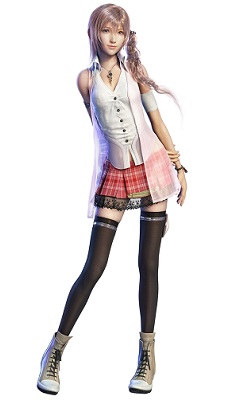
These songs that have been in EVERY Final Fantasy game are completely absent from the game. Square says that they want to modernize the series as their excuse, but the game feels incomplete without these essential songs that we fans have grown to love.

The American soundtrack has also been severely cut down. The Japanese soundtrack has well over a 120 songs, but the American version barely has 80. Square cut down the American version for the Xbox 360 and to westernize the series. Since many of the songs in the Japanese version contain Japanese lyrics, Square either filtered these songs or completely cut them out of the American release. Several songs were also cut out of the Playstation 3 version because of the Xbox 360. The music that IS featured in the game is nothing too special. In my opinion, its the worst that the series has seen. The music goes from being classically instrumental to a strange experimental techno-type of music. The game still contains the Chocobo theme, but the lyrics have been changed into English. In short, the music is nothing special. Which is a pity for the Final Fantasy series. Let's hope the music to Final Fantasy XIV is better.


Design
Final Fantasy XIII is a game that contains an engrossing story, fantastic graphics and gameplay. Final Fantasy XIII is the best Japanese RPG to be released since Final Fantasy XII. The game is just as detailed as every other game in the series, and in terms of graphics, it sets new standards. The high definition graphics are groundbreaking and the game literally looks like a movie.


Since this is a Final Fantasy game, everything is top-notch. There are almost load times, and the game runs perfectly, without a installation. The game also takes up only 500 kb. The voice acting and dialogue is surprisingly good. With the exception of the character Vanille, the voice acting is near flawless. However, I cannot stand Vanille. She may have one of the most annoying voices in history. Even though she gets better throughout the course of the game, she is still terrible and makes more noises than a tiger on crack.
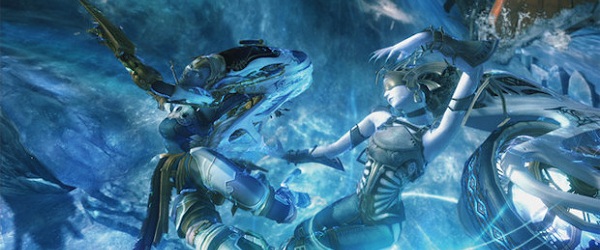

The programmers took the liberty to go back and dub the characters so that when they speak, the movement of their mouths actually matches the words coming out of their mouths. The game is surprisingly dramatic. The game does a very good job at not being a mellow-drama, and instead it feels like a drama. The music in the cut-scenes is moving, but several songs in the American release have been replaced with a single song of a woman singing. This song plays throughout most cut-scenes since the original songs in the game have been taken out.


Conclusion
In the end, Final Fantasy XIII is not the best game in the series. However, it is an instant classic. I think it will be remembered by fans around the world. The game offers a unique perspective on the series that the other games haven't shown. The game at first feels like a strange experiment since it is so different. But as you progress through the game, the "experiment" begins to feel like an old series that we all love.


Whether you like it or not is completely up to you, I love the game. I have a few complaints but those aren't enough to stop me from saying that this game is fantastic. I think that Final Fantasy XIII is highly under credited by critics. With a game like Final Fantasy, it's better to listen to the fans; and this fan is telling you that if you have a PS3, then buy Final Fantasy XIII.

Ratings
Gameplay....1010
Graphics......10/10
Story.............10/10
Sound...........8/10


Cosplay


Monday, 2 January 2012

Halo Forerunner Saga


The Forerunner Saga is a trilogy of Halo novels focusing on Forerunner life 100,000 years before the Human-Covenant war, being written by Greg Bear and published by Tor Books.The first novel, titled Halo: Cryptum, was released on January 4, 2011. The second novel, titled Halo: Primordium, is set to be released on January 3, 2012.

Originally known only as the "Forerunner Trilogy", the series was officially announced at the Emerald City ComiCon in Seattle, Washington, where its author, Greg Bear, made a guest appearance.The first book's working title was "Antediluvian".The word "antediluvian" means, "of or belonging to the period before a flood," hinting that the novel takes place prior to the Forerunner-Flood War. The series reveals a great deal of new information about the Forerunner-human interactions in ancient history.On October 11, 2010, the official name of the book was revealed to be Halo: Cryptum.
During the writing process artists such as Sparth of 343 Industries created several illustrations for Halo: Cryptum. Frank O'Connor has mentioned that these illustrations will eventually be released in an art book.

Synopsis
Set during the golden age of the Forerunners, the series touches on the origins of humanity and the contacts with Forerunners and humans, as well as explaining the connection between the two and humanity's status as "Reclaimers". Forerunner technologies are explored in detail, and many new elements about the Forerunners are introduced, such as their political system and social structure. The characters of the Didact and the Librarian, introduced in the Terminals in Halo 3, are featured as central characters in the series.


Halo : Cryptum
Released January 4, 2011,Cryptum focuses on a young Forerunner known as Bornstellar Makes Eternal Lasting, a rebellious Manipular from a family of Builders, the highest and most politically powerful rate of the Forerunner. However, instead of following in his father's footsteps and becoming a Builder, Bornstellar is obsessed with exploring artifacts left behind by the Precursors, an enigmatic galactic civilization that preceded the Forerunner. His father sends him to the planet Edom in a distant system known as Sol to work with the Miners to come to terms with his duty as a Builder. Eventually, Bornstellar crosses paths with two humans on Earth, forever changing the fate of the galaxy.


Halo : Primordium
Announced alongside the official press release of Halo: Glasslands,the sequel to Cryptum is to be released on January 3, 2012. Primordium is centered around Chakas and Riser, the two humans who accompanied Bornstellar in the first novel as they traverse an embattled Halo installation, facing a multitude of hurdles on their way and discovering the ancient plan of vengeance devised by the Precursors against the Forerunners.According to Greg Bear, Mendicant Bias will play a prominent role in the novel


Tuesday, 27 December 2011

Haunting grounds

Review by LemonPenguin


Introduction
Haunting Ground (or Demento in Europe and Japan) is one my favorite survival horror games. Now let me tell you why. First of all, it's a very unique game. But, like most unique games, it isn't for everyone. Haunting Ground is a survival horror which was developed and publish by Capcom in 2005, for Sony's PlayStation 2. It's about an 18-year old girl named Fiona who wakes up in a strange castle and pairs up with a white German Shepherd to escape the castle.


Story
18-year old Fiona Belli awakes in a small dog cage after surviving a car accident. Dressed in only a blanket she sneaks out and makes her way towards a huge castle. Once inside, she's greeted by a creepy maid named Danielle who gives her Victorian-styled clothes to wear. Things just get weirder from then on. After being chased by the childish, albeit humongous groundskeeper who just wants to squeeze her a little (more like crush her to death), Fiona finds a white German Shepherd painfully tied to a tree. She sets him free and remembers his name from a collar she found earlier: Hewie. Fiona and Hewie team up to escape the castle and it's strange inhabitants. It seems that everyone except Debilitas once something...from inside of her. And they will stop at nothing to get it. It's up to the player to help Fiona and Hewie through the castle, escape the pursuers and survive. Along the way they meet a dangerous and mentally disabled groundskeeper, a creepy and unstable maid, a creepy hooded stalker and a mysterious old man who appears to be helping them, or is he? I give Haunting Ground's story a 9/10. It's very original and the story is very well developed throughout the game with plenty of cinematics and even a small plot twist that will make you want to escape the castle even more.


Music
The music in Haunting Ground/Demento was composed by Seiko Kobuchi from the Resident Evil series and she did an incredible job with it. Each pursuer possesses their own chase music and each stage of the game has different background music for when you're not being chased. Not only that, but everyone gets their own boss music. The background music is pretty creepy and will really keep you on edge, and the chase music really gives you a sense of danger. There's also a really heartwarming theme for Hewie. I give Haunting Ground's music a 9/10 for how well it blends in with the atmosphere and for how really well done it is.


Graphics
Haunting Ground's graphics are really good. The characters are really realistic and it's not even uncanny valley realistic like in Clock Tower 3. The characters are really well done and the backgrounds and areas are well textured and constructed. The design is fairly Gothic (then again, it is a castle) and pretty chilling at the same time. I give Haunting Ground's graphics a 10/10 because of how well done they are. 


Gameplay
Haunting Ground's gameplay is very original. To start off, it's very similar to Clock Tower 3's gameplay. In case you've never played or even heard of Clock Tower 3, I'll tell you how it works. You and Hewie walk around the level looking for items and such to complete puzzle and work your way to the next area. All you have to do is find an item or two, do a little backtracking, get some keys and carry on. Simple right? Not really. While you're exploring, certain cinematics, actions you perform or simply after a certain amount of time passes, your pursuer will begin chasing you. While being chased you cannot examine objects or use items. All you can do is choose to either run and hide or fight. Fiona isn't very athletic so she's fairly weak and all she can do is kick and do some form of tackle. However, Hewie is a dog. Dogs have teeth. Using the right analog stick you can command Hewie to sit, search, come to you and, of course, attack. Hewie's main attacks consists of biting the enemy. 

He can also learn new moves like dodging. You can also charge his attack for extra power. However, the pursuers will not only attack Fiona but also attack Hewie. As Hewie gets hurt he becomes slow and feeble. You can replenish his health using certain food items. If Hewie gets hit too many times, he'll collapse temporarily. Or, if you're on Hard Mode, he'll die and you'll get a Game Over. Hewie also has an invisible friendship meter. You can make him like you more by praising him when he's good and feeding him treats. However, if you hit him or scold him too much, he'll like you less. The more Hewie likes you, the more he'll listen to you. If he doesn't like you, he'll just run around and ignore you and even attack you if you get him really angry. Now for Fiona. Fiona, unlike most video game characters, get scared. Like in Clock Tower 3, you have a Panic Meter, and if you're Panic Meter reaches max, you'll go into Panic Mode. There isn't actually a gauge for the Panic Meter in Haunting Ground. The Panic Meter is the screen. As Fiona gets scared, the colors begin to fade from the screen, the screen begins to pulse and Fiona begins to stumble a bit while running. While in Panic Mode, Fiona will move uncontrollably and will trip all of the place. You'll know when you reach Panic Mode because the screen goes negative for about a second and Fiona lets out a shrill scream. The screen turns almost completely black and white and it becomes a lot harder to control Fiona. Also, the only command you can give Hewie while in Panic Mode is "help" and you better hope you've been nice to him or he's not going to help you. Now here's the catch: While in Panic Mode, you can fall over. This is your weakest position. Once fallen, you can't get up until Panic Mode is over. The screen becomes nearly completely black and white and pulses. All you can do is mash buttons and try to crawl away as your pursuer comes in for the kill. Eventually though, Fiona will get up and Panic Mode will end. So how do you die? First of all, Fiona does have health of some sort, but her health doesn't actually run out. If Fiona gets hurt or if she runs for long periods of time, her stamina runs out and she becomes much slower and weaker. You can replenish your stamina by using certain items or by drinking water at the sinks scattered throughout the game. Anything that kills Fiona will be a one hit kill. No second chances. ..


Your pursuers can attack Fiona and take away her stamina and cause her to panic. They can also use their "finishing moves" of sort which can kill you. Basically either you get hurt and panicked, or you die. For example: Debilitas, the game's first pursuer can either punch Fiona, or he can grab her and put her in a death grip which will kill her if she doesn't get out soon enough. It seems easy enough as long as you stay away, but your pursuers are pretty fast and Panic Mode makes you extremely vulnerable. If fallen while in Panic Mode, your pursuer can easily come in for the kill. Now onto hiding. If you don't want to fight, there's plenty of places in the game to hide. However, don't hide in the same place too many items or your pursuers will find you easier. There's also several traps in the game that can kill you, so be careful of that too. I give Haunting Ground's gameplay a 10/10 for how original and fun it is. ..


Replayability
Haunting Ground will only take you about 10 hours or less to beat the first time. But, it has A LOT of replayability. To start off, there's 4 different endings to get. Not only that, but there are 11 different play-types to get. What play-type you get depends on your statistics at the end of the game such as your play time, how many items you found, your dog level, your Panic Mode count etc. And, to top things off, both Fiona and Hewie have multiple costumes that can be unlocked which can boost their attack, stamina etc. Then there's also Hard Mode which can is unlocked after beating the game. In Hard Mode the pursuers are faster and stronger and Hewie can actually die, resulting in a Game Over. Also, there are more medallions and less items. Medallions can be used to create alchemical items and equipment to help help you through the game. I give Haunting Ground's replayability a 10/10 because it's one of the most replayable games I've ever played. 


Overall
I suggest you try to rent Haunting Ground before you buy it. It's not for everyone, but if you like survival horror you should definitely check it out. It's not "Silent Hill scary", but it does keep you on edge. If ever given the chance to buy it, definitely do. It's a great game and is definitely underrated in my opinion. I give Haunting Ground a 10/10. It's a great survival horror game and whether you're a fan of the genre or not, you should really check it out.

  
Ratings
                                                                                                                                                   
Gameplay....9/10
Graphics......9/10
Story............10/10
Sound..........8/10 

    
Cosplay


Sunday, 25 December 2011

Final Fantasy 7 - Crysis Core (PSP)

Review by Darksun45230


Over ten years ago the role playing game called Final Fantasy VII premiered on the Sony Playstation. A lot of people, and I mean a lot of people claimed it to be the greatest game of all time. If you ask this reviewer, yes, he was a fan too. The contents of this review however will not be based on the popularity of the Playstation version, but of the contents of this game, and its own merit.

Storyline
The game takes off with Zack Fair around familiar scenery. From the very beginning the player is taken on an adventure deep within the world of Final Fantasy VII. Soon you explore the mindset of optimistic Zack and his friends, mentors, and heroes.


We're introduced to vivid, realistic characters. With doubts, fears, and pride, all with just a few pieces of dialog. If you don't pick up on the subtle hints, you might get lost. As you move on, you travel to familiar scenery that one would find in Final Fantasy VII. Meet people, both new and familiar. And unveil mysteries to people that's only dream is to regain their lost pride. From beginning to end Crisis Core delivers a witty, romantic, and tragic story leaving one moved in heart and soul by story's end.

Gameplay
First, you have to ask a few questions. Does this compare in gameplay to Final Fantasy VII? What's been changed? Will my experience be different from before?


The Final Fantasy series has evolved from a turn-based combat system. One you might find in titles like Dragon Quest VIII or Final Fantasy X. Now we enter the time of the action based combat system. You've seen these types of combat in Kingdom Hearts and Final Fantasy XII. So is it better?

The changes are many making the adapting no easier. With a turn-based system, your characters and enemies stood in place. You could take all the time you need to make the next attack. And when you did you scrolled through a small menu and selected it.

Now let's compare that to the action-based combat. Your enemies move around a lot. You too are not limited by your movement. However, you don't have all time in the world to attack, because enemies don't wait. When you want to attack you scroll using the same menu and selecting an attack. And unlike a turn-based system, it acts immediately.

Accuracy has changed too. In a game like Final Fantasy VII, in turn-based combat all one needed to do in order to hit the enemy was cast a spell or attack normally. However in Crisis Core, you have to know who you want to hit. Here's an example. I want to use the magic Blizzard (the renamed Ice) against an opponent. The catch here is that a large block ice appears over the enemies head, that enemy has to stay put for less then a second for it to connect. If he doesn't, you miss.

Many environmental factors apply now. It's no longer just scenery. In an action based combat system, it's a disadvantage to be on a narrow catwalk during battle. In fact it's gotten this reviewer killed on many occasions.

In Final Fantasy VII, you had slots on your armor that allowed you to attached magic stones to them. These stones allowed you to use spells like Fire, Ice, and Cure. Now in Crisis Core we have that and more. Materia doesn't act all that different in Crisis Core. The catch is that you start out with only a few slots. And stay that way for a long time. The days where you could pack eighteen Materia into your armor is over. Long over. Now, you have to decide who you want to play as. This is done in order to balance the action-combat system. Plus the negative stats have been removed.


Where did the summoning go? It's not dead. You still can summon. However, it's not as easy. I'll get more into this later as we approach the DMW system.

Good news. You can level Materia. The difference between the Materia leveling in Crisis Core and Final Fantasy VII is simple. You get stats from Materia. In FFVII, you were restricted to Materia where when applied increased a certain stat and decreased another. Now there are no negative stats, just positive. And to make this even better, they added a whole new system, the Materia Fusion system.


The Materia Fusion system mimics a fusing. You combine Materia (taking away from the SP points, which are gotten from hitting enemies in battle) and making a whole new Materia to level. There are is a list of Materia combinations that make better Materia. Some Materia can only be acquired from Materia Fusion. It's a great way to get those extra stats.

Moving on, we arrive at the DMW system. The Digital Mind Wave System. How does it work? Better yet, what does it do? The DMW acts as a leveler, a gauge to use special attacks called limit breaks, and to summon monsters.

We begin at leveling. In this game, there is no experience. Instead, we have the DMW reels. Let me begin with how it works. When you hear the words “Power Surge” during battle a reel appears. There are faces on each reel; if the faces match by the end of cycle then you activate a limit break. It happens often. Now how then do we level? It works in a similar way, because there is numbers on the side that reel as well. When those numbers match “777” you level. Now you may be wondering how this is all possible. You may be asking ‘hey, how the heck can anyone play this game if leveling is so random? I don't want to end up level ten by the end of the game or overpowered too early.'

My best guess is that there is a hidden experience counter that gains as you defeat more and more enemies, or hit them. When that counter reaches the max the reels start and you level up. You can level up Materia in the same way as well. Materia also has its own hidden experience count depending on if it's attached to your armor. Sweet.

At last we arrive at summoning. What's changed? Will I like those changes? It's up to you. Unlike the system we were so used to in Final Fantasy VII where all one had to do was attach a summon Materia, this involves using them via DMW. When we achieve “Power Surge” and the limit faces are reeling, they sometimes change to befit a whole new reel. Summoning faces. Like Ifrit or Bahamut for example. When all those faces match then you summon them, which are basically performing an attack. Luckily, we can skip the sequence by pressing a button and getting to the results. Thank you!

Acquiring summoned monsters has also changed. Instead of receiving Materia outright, you must defeat them during a side-quest; buy them at a shop, and many other ways. Along with an astounding array of abilities that accompany them whether it be Odin's Zantetsuken, Bahamut's Mega Flare, or Phoenix's Rebirth Flame. The summon monsters are not something to pass up.

I did mention the Limit Breaks. For those new to Final Fantasy VII, a limit break happened when a character took a lot of damage. What is it exactly? It's an attack that did damage beyond what a normal character could do. Hence, Limit Break. In Crisis Core we explore Zack's many limit breaks. I can't tell you who the faces belong to sadly without giving away key plot points. Each face has its own limit break for Zack; let's start with the shadow limit. You'll get a lot of this at the beginning of the game, where the reel lands on a shadow face. When it does you'll perform a series of random slashes at one enemy. There are others that allow you get a critical hit each time you strike at an enemy, one that completely heals you and then some, and one in particular that performs a nasty combo on an enemy. Limit Breaks are a nice addition to Crisis Core. Don't neglect them.


Now it's time for the bread and butter of the game, missions. The storyline is separated into many missions; many involve combat in one way or another, while some don't. From the start, you are introduced to these quests, three-hundred total, that involve defeating a certain enemy, a summon monster, and heck about 1000 soldiers. With three-hundred missions it's bound to get repetitive. But they increased the difficulty so at least we can have fun!


You won't find WEAPON in this game. Sadly, we don't get to fight hulking monsters like that. So what does that mean? There're no bosses? No. At the end of the three-hundred mission road, is none other then a woman named Minerva. She serves as the games almost unbeatable boss. Who is she? Well, you'll find that out.

Though same changes are small while other big, they affect gameplay so that the overall experience is different. Will your experience be different? Yes. Will it be worse? That's up to you to decide.

Graphics & Music:
As soon as you pop in the UMD and start playing you'll recognize a familiar tune. Ask yourself, ‘haven't I heard this before?' If you have then you've played Final Fantasy VII and watched a few of the compilations. Right away we hear the music played from the Bomb Mission. Of course it's been radically altered, but the same nonetheless. So will this game do ruin to the music you've come to admire of the years? Do you really care? What about graphics? Are they truly what this reviewer is talking about?

The tunes you find Final Fantasy VII and LAST ORDER FFVII are very much present here. Often music has been redone with a different instrument. Other's are completely new, and sound great. With the sync of a heavy bass guitar along with thundering drums, it makes for one heck of a soundtrack!

Graphics, what makes them so special? Why am I so avid in saying that they are the best on the PSP? Let me start. At say, summoning. When a summon attacks, the graphics are so clear and definite that you can see the smoke pouring out of Ifrit's mouth. Maybe it's the stringy strands of energy forming at the base of Bahamut's mouth when he performs Mega Flare that get me. Must I go on? Okay, I will. Maybe it's the sparks that fall from Odin's blade when he brandishes it? Or dull blue flare in his eyes as he rides along a broken battleground waiting to deliver the next blow. It's not what's been placed; it's where they've been placed during the story. It's hard to explain without revealing spoiling the story. But you get the idea.


Overall, it's easy to be amazed by these fluid, flawless CGI sequences. As for the soundtrack, it will have fans of the music hooked, heck; I'm listening to it right now!

Overall
Angels have but one dream. To find this out one must play. Crisis Core: Final Fantasy VII is the best game of the Role Playing genre. If not, one of the best PSP games of it's time. With unforgettable, realistic characters, the best music and graphics to date, and an epic yet tragic storyline about lost pride, this is a worthy title for all.


Ratings

Gameplay....7/10
Graphics......9/10
Story...........10/10
Sound..........7/10


Cosplay